Monday, 18 July 2011

Surgical Options

I have been doing research into various options available for surgery.  I want to be prepared so that when D-day comes we have explored all our options and feel confident with the technique and surgeon we decide on.


I have discovered that there are doctors performing different styles of scoliosis surgeries for children around the world, and also within Australia.  From what I have discovered so far these are the main options for the growing child. 
NB. This is just info I have collected from websites, forums and other contacts. I approached this with a blank slate, as a mum, not a medical professional.


Growing Rods - Single or Dual
The theory of  growing rods is to allow for continued, controlled growth of the spine. This is done along the back of the spine. One or two rods span the curve under the skin along the length of the spine. The rods attach to the spine at the top and bottom of the curve with hooks or screws. The curve is not fully corrected, but 'controlled' whilst the child is still growing. They then return every six months to have the rods lengthened via keyhole surgery. 


There are a number of possible complications. For example, hook or screw dislodgement, rod breakage, infection, high sensitivity and poor healing of wound site for recurrent lengthenings.  A family I have contact with in the US have an 8-year-old who has gone through 8 surgeries in 2 years due to rods breaking and screws loosening etc.


Vertical Expandable Prosthetic Titanium Rib - VEPTR
VEPTR rods were developed for children with scoliosis with chest wall abnormalities or lung involvement. They attach to the ribs and also involve regular lengthenings as the child grows.  
This technique is unfortunately thought to be less effective in curves that do not involve thoracic spine or chest cavity abnormalities.  There are similar complications to growth rods in regards to infection and wound site, however from what information I have read, I believe less hardware problems. 


Vertebral Body Stapling
A technique to 'staple' the vertebrae together in an attempt to strengthen the spine, an alternative to bracing.  It is not suitable for curves over 45 degrees. However some surgeons combine growth rods with vertebral stapling as an additional support to the growing rods. This is dependent on the type of curve, the position and the correction achieved with the rod placement.  The same complications as growth rods exist.


Luque Trolley or Luque Rod system
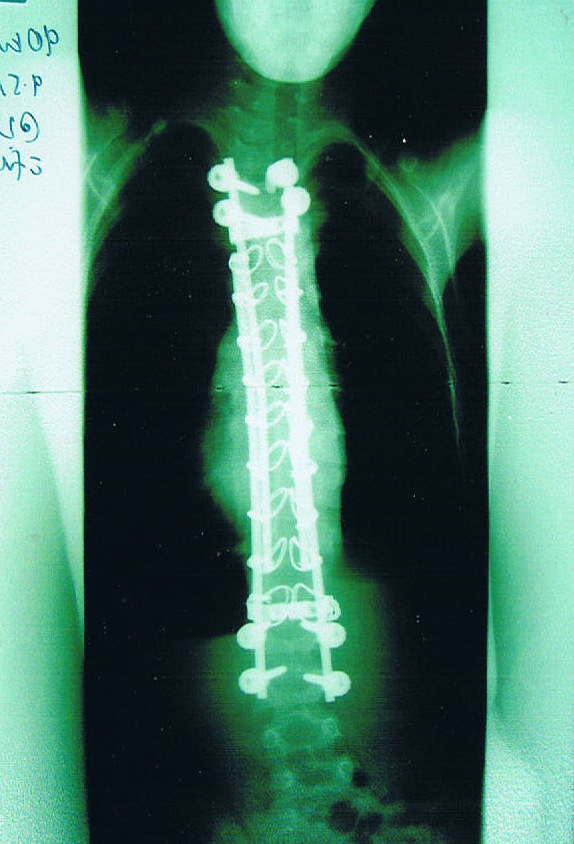
A rod system which consists of 4 rods-2 each side of the spine. On each side of the spine, one rod is anchored at the top, the other anchored at the bottom.  Then on each pair of rods on each side, there are intermittent loops of wire attached to the spine holding the pairs together. So as the child grows, the rods can slide apart a bit more. This system may mean less surgeries as the 6 monthly lengthenings are not required.  However, since the wires pass through the spinal canal, this system poses a greater risk of neurological damage than other systems. 


Links:
Futuremedicine - Current concepts early-onset scoliosis
www.scoliosisnutty.com
Growing Rods
Scoliosis Research Society - growing rods
Scoliosis Research Society - idiopathic - growing rods
The growing Spine e-book (pages 449-467)
VEPTR
Scoliosis Research Society - VEPTR
Medcastle Scoliosis VEPTR
Veptr support site
VBS
Vertebral Body Stapling Procedure for the Treatment of Scoliosis in the Growing Child
Scoliosis texas - VBS
Spine Universe VBS
Luque
Luque rod system
Review of Luque system
Review of Luque System 2
Review 3

Sunday, 10 July 2011

New Brace

We got final adjustments made to the new brace last week.  Here is the final product!
It is essentially the same design, but higher at the front of the chest to force her shoulders and upper back into a better position. 


Tuesday, 28 June 2011

Perspective from a 20 year old

A young woman with Beals Syndrome recently posted the below on an online Beals Support Network.  I asked her if I could re-post it here for those interested in what it has been like for her living with Beals Syndrome.


I'm 20 years old and have a mild form of Beals. Although it is mild, it still hurts (I'm a visual artist and I'm always using my hands) and I have to deal with people commenting on my appearance, usually describing my features as "weird" or just "ew." 


I wanted to say something to all the parents of kids with Beals. Kids with Beals need to build a tough shell, because other kids can be cruel as hell, and if they let it get to them, it'll ruin their life. I had to realize on my own that my "weird" appearance was the one I was always going to have- and I would have to come to love it. 


Please tell your kids to stay strong, and pity the people who are rude to them. Instead of feeling hurt by others comments, tell them to look at how sad it is that they would want to hurt someone's feelings in the first place. I grew up fast (most of us with Beals do, at least physically) and am thankful for all the struggles I had to deal with early on, because I would not be able to move forward and achieve the things I have accomplished today without going through it all. 


If you have a teenager, or even a younger kid, and they need someone to talk to, please feel free to message me. Actually, I encourage you to. It's a very lonely feeling knowing you suffer from something that most people don't even know exists- let alone other kids. 


Today I am a happy and successful young woman (so far...) and the fact I have Beals has not slowed me down. It has done the very opposite... it has motivated me to do everything I want to do in life, and all those stupid comments from other kids officially have no validity whatsoever.


Keep strong, and carry on.  Lily

Thursday, 23 June 2011

Casting for a new brace

Evelyne was casted for her new brace yesterday.  It was our third casting without a general anaesthetic.  I took the camera in this time as it's been hard to explain exactly how it all happens. 

She was amazing! She was clearly not very keen, but stayed still and whimpered only when the plaster first went on.  I was very proud of her! Sam sang songs to her while it was happening, and watched with interest. I should have taken a photo of him too!

Getting ready with a stocking type covering against her skin
Strapping her on the bed
My mum calls the 'bed' a 'rack'

Applying the plaster bandages


 Waiting for the plaster to dry
Cutting the plaster off


We will pick up the new brace next week. She picked pink butterflies! It will be a lot higher than her last brace and therefore more restrictive. We are hoping and praying she will tolerate it and also that it may be effective in holding off operating for a bit longer.

Friday, 10 June 2011

Spinal Conference

Last week we got an amazing opportunity. A spinal conference was conducted at Westmead with specialist surgeons from Australia and overseas. My doctor had originally informed us he would show Evelyne's x-rays to them to get their feedback on future treatment. Last week I got an email requesting that Evelyne come to be presented!


It was a strange day.  I was so excited and nervous about what would happen.  I had no idea what to expect. My only information was that she would be 'presented in a lecture theatre'. I was excited that we got the oppotunity to be assessed by overseas specialists, yet nervous about how they would treat her.


We arrived along with 4 other children and their parents and were led into a room next to the lecture theatre.  We were told that one by one we would be called for to be 'presented'.  While we waited (approx 2 hrs) we were supplied with catered food and drink and got the chance to relax and chat.  One parent commented on how well we were being treated.  Another stated "That's because we're the entertainment!"  My doctor was also being especially nice. Were they helping us? Or were we helping them learn?  


It was a bit of both I think.  When Evelyne was presented, information about Beals Syndrome was also presented.  It was clear that some may not have been that familiar with this disorder. She was laid on a bed at the front of the conference (approx 40-50 people) and given a teddy to hold. While the majority of the conference stayed in their seats making notes, 4 doctors came forward to examine her.  I was impressed with how well they treated her and how well she behaved. One in particular knelt down and talked to her and showed her his funny cartoon tie.


After only 5-10 minutes being assessed, we were asked to leave so the doctors could discuss her case.  Last night I finally got a phone call from the doctor with feedback (the special treatment only lasted as long as the conference!).


The news however is more promising than our last assessment.  The specialists (I think from the U.S) suggested an alternate brace design.  They advised that with higher support, possibly over her shoulders, we might get slightly more time before needing to operate.  We are hopeful that this might be the case!


She loves the bear!


Stethoscope image: jscreationzs / FreeDigitalPhotos.net


Wednesday, 1 June 2011

Casts and Braces

I'm by no means an expert in this area.
All I know is what I've experienced and a few snippits I've learnt recently from my Beals connections. The braces and casts vary depending on the height of the curve and the specialist team.  Some examples of braces and casts I've seen recently:


In infantile scoliosis a cast or brace is used to control the curve.  In some cases of infantile scoliosis, the curve can be improved.  One of my new 'facebook friends' has a son in this situation.  Her son does not have Beals Syndrome, but was born with infantile scoliosis.  He is responding well to casting.  See his progress here


Unfortunately, in Beals Syndrome, the curve tends to continue to develop regardless. 
As you can see from Evelynes x-rays in my post on scoliosis.
Casting or bracing can still be used however in an attempt to slow down the progress of the curve.  I've learned recently that a plaster cast tends to get better results than a brace.


As you may imagine, casts in babies or toddlers can be difficult.  
They can be hot, heavy, and uncomfortable. They make fitting clothes difficult. 
If they're not walking yet it is difficult to hold them and carry them around. 
Casts can't be removed, so no baths.  
It's also important to try and keep them clean and dry. 
Fun with a toddler!


Some ways I managed were:

  • Gorgeous, large, waterproof bibs made by my mum
  • Still allowing some 'controlled' waterplay with a smock
  • Antiseptic powder for those nappy explosions
  • Smaller nappies, changed more frequently to fit under the cast
  • Larger, elasticised clothing such as leggings
  • Clothes with higher necklines
  • Unfortunately avoiding things like sandpits and the beach
  • A portable air conditioner in her room in summer
  • A lightweight pram in the boot at all times.  Other mums I know have used slings or backpacks.

The last picture is of course what not to do!!

Monday, 23 May 2011

Dealing with disappointment

How do you deal with bad news, or bad results? When you hope for improvement and find out the opposite?


Eve's spinal Clinic on Thursday was unfortunately one of those days.
Her curve has increased again, and it appears that it will not be held off by bracing or casting.
The surgeon has informed us he will need to start operating sometime soon, which means, within the next year.
After reading more online it appears that not only does scoliosis in Beals Syndrome tend to 'rapidly progress', it also at times cannot be slowed without surgery.


How do you respond to such news?   
Do you cry? Do you get angry? Ask God, why her? Look for second opinions? 
I just felt sad and disappointed.  


After a few tears (ok, lots), I have moved on to trying to find a positive through this.
1. Less pain and discomfort?  I have joined the Scoliosis Australia Forum, and many people who have been through surgery report less pain afterwards.
2. Good timing.  A team of specialists from around the world are visiting next week.  Our surgeon is going to present Evelyne's case to them and get their expert advice.  
3. She will be taller!
4. God has a plan for her. I need to trust that He is in control. 


Romans 8:28 (NIV)
And we know that in all things God works for the good of those who love him, who have been called according to his purpose.