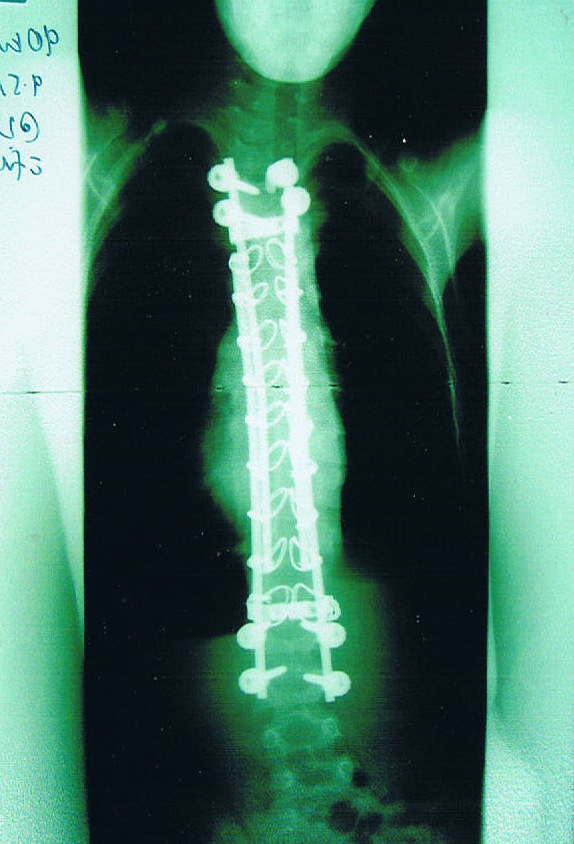
Two weeks ago Evelyne had another major surgery to remove her old Magec rods and insert new longer rods. Since her first surgery, Evie has been lengthened every 3 months, and reached the end length of her rods sooner than expected. A result of a Beals Syndome catch 22. Whilst the flexibility in the connective tissue is what made Evelyne's spine super bendy in the first place, the flexibility also meant her surgeon could straighten her relatively quickly, thus running out of length.
Leading up to the surgery Evie (and myself) were very anxious. Unfortunately having been through it before meant we were not looking forward to the surgery or aftermath. Anticipating the pain she would be in was the main worry. We distracted ourselves by planning a brilliant 9th birthday party the weekend before. As well as a bit of activity planning, relaxation oils, music downloads and lots of prayer.
The operation was longer than expected, so Jon and I were pleased when the surgeon emerged to tell us it was all over and she was in recovery. He informed us that much to his surprise, the existing screws had come loose in her spine. In his wording, two were extremely loose and one was "swinging in the breeze"! He was surprised that she had not been experiencing associated pain. We had hoped the surgeon would be able to just replace the actual rods, however, he had to remove all 4 screws, with 3 larger diameter screws, whilst having to drill a new hole for the 4th. He was happy that the anchors were now very secure and as a result she won't have the same restrictions as her first surgery. He was also confident that her recovery would be quicker than last time. All in all, very positive news.


The following days in hospital were still painful and long. Long days and nights with frequent repositioning required. Evie also had some issues with pressure injuries this time, but as an OT, I'm glad to be in the right industry to know how to deal with these! We were prepared with movies, music and audio books, and the DVD stand was again a godsend. Overall, everyone was pleased with her progress and she was able to get up and walk earlier than last time. The surgeon was happy with her x-rays, so we left hospital on her birthday with a bit of determination to get out of there!
 |
| Heading home |
For the last week Evie and I have stayed in Sydney, at our 'home away from home'. My parents have opened up their home, and in fact partially designed their house with Evelyne's medical appointments and recoveries in mind. I am so grateful to have this provision, and my mum to look after us! We have enjoyed many hours of colouring, visits from cousins, craft activities, movies, and our now tradition of her first outing to Cold Rock Icecream. It has been a smoother process this time, knowing what the main issues would be. So were well set up with a lowered bed, lots of pillows, shower chair and toilet rails brought from home.
Today we have finally made the trip home to Bathurst. Dosed up on pain meds and lots of pillows, it is always sad to leave my parents, but will be so good to be home!
I have been doing research into various options available for surgery. I want to be prepared so that when D-day comes we have explored all our options and feel confident with the technique and surgeon we decide on.
I have discovered that there are doctors performing different styles of scoliosis surgeries for children around the world, and also within Australia. From what I have discovered so far these are the main options for the growing child.
NB. This is just info I have collected from websites, forums and other contacts. I approached this with a blank slate, as a mum, not a medical professional.
Growing Rods - Single or Dual
The theory of growing rods is to allow for continued, controlled growth of the spine. This is done along the back of the spine. One or two rods span the curve under the skin along the length of the spine. The rods attach to the spine at the top and bottom of the curve with hooks or screws. The curve is not fully corrected, but 'controlled' whilst the child is still growing. They then return every six months to have the rods lengthened via keyhole surgery.
There are a number of possible complications. For example, hook or screw dislodgement, rod breakage, infection, high sensitivity and poor healing of wound site for recurrent lengthenings. A family I have contact with in the US have an 8-year-old who has gone through 8 surgeries in 2 years due to rods breaking and screws loosening etc.


 Vertical Expandable Prosthetic Titanium Rib - VEPTR
 A technique to 'staple' the vertebrae together in an attempt to strengthen the spine, an alternative to bracing. It is not suitable for curves over 45 degrees. However some surgeons combine growth rods with vertebral stapling as an additional support to the growing rods. This is dependent on the type of curve, the position and the correction achieved with the rod placement. The same complications as growth rods exist.

Luque Trolley or Luque Rod system
A rod system which consists of 4 rods-2 each side of the spine. On each side of the spine, one rod is anchored at the top, the other anchored at the bottom. Then on each pair of rods on each side, there are intermittent loops of wire attached to the spine holding the pairs together. So as the child grows, the rods can slide apart a bit more. This system may mean less surgeries as the 6 monthly lengthenings are not required. However, since the wires pass through the spinal canal, this system poses a greater risk of neurological damage than other systems.
Links:
Futuremedicine - Current concepts early-onset scoliosis
www.scoliosisnutty.com
Growing Rods
Scoliosis Research Society - growing rods
Scoliosis Research Society - idiopathic - growing rods
The growing Spine e-book (pages 449-467)
VEPTR
Scoliosis Research Society - VEPTR
Medcastle Scoliosis VEPTR
Veptr support site
VBS
Vertebral Body Stapling Procedure for the Treatment of Scoliosis in the Growing Child
Scoliosis texas - VBS
Spine Universe VBS
Luque
Luque rod system
Review of Luque system
Review of Luque System 2
Review 3
One of the possible features of Beals
Syndrome is scoliosis. It does not develop in all Beals
cases, and some cases will only develop in adolescence or later in life. Due to the connective tissue disorder the scoliosis will continue to worsen with age if not treated. One article I read, stated it has a 'tendancy to rapid progression'. If not treated this can result in restrictive lung disease and the possibility of other issues with internal organs.
In Evelyne, we discovered the scoliosis at 4 months of age. The first x-rays showed a small but distinct scoliosis (first x-ray below). She was booked into the spinal clinic to monitor the curve. Each x-ray showed the curve clearly worsening.
At this stage they wanted to monitor the curve, and await the diagnosis before proceeding with any treatment. The hope was that the spine might stabilise. The physios made a special chair for Evelyne in order to try to protect her spine and limit degeneration. She was known as "Queen Evelyne" at playgroup - sitting on her throne!
 In December 09, when the diagnosis of Beals was confirmed, the Doctors went into overdrive! We had a meeting with about 5 specialists in the room to discuss treatment. It was decided that Evelyne should be put straight into a plaster cast.
Evelyne was in the cast for 3 months. This was an extremely difficult time. The cast was made from plaster covered with fibreglass. It was heavy and hot, and difficult to change nappies and keep her clean. She could not bath or swim and struggled under its weight as she tried to master standing and walking.
We moved onto a fibreglass brace from this point which can be removed for about an hour a day. In this first brace the curve was reduced to 35 degrees. Although I was surprised it was still so high, the doctors were happy with 'maintaining' the curve at this level. In Evelyne's case, the aim to cast or brace was not to 'cure' or 'fix' the curve, but to maintain it to a safe level until they operate at some stage in the future. In the second brace the curve had worsened to 40 degrees. The third brace was thus organised. We will find out how the curve is progressing in this brace later this week.
Brace 1 Brace 2 Brace 3 - with brother Sam
I plan to write more in the future about: my tips and tricks for living with casts and braces; dealing with general anaesthetics; casting without sedation; future surgery.